3rd Quarter sure feels "festive," no? Hope you felt that sarcasm... Holy cow. 3rd quarter is consistently the most exhausting quarter of the school year, and yet EVERY single year it sneaks up on me and presents itself as though it were a novel concept.
So I'm finally wrapping up my 2nd year of SpringBoard, which is to say, 2nd NEW year as I taught 7th grade last year and 8th grade this year. I have to say, I always like what I'm teaching, but it is also exhausting. But let me explain why I, personally, feel so exhausted with it. I know that many of the other SpringBoard teachers out there have mixed feelings about it, many of which are negative.
I feel the stress of it because I'm supposed to teach at the same pace as my colleague who also teaches the same grade level. Makes it hard to slow down or speed up to accommodate my own students as we need to be fairly close to each other (same day, same page kind of structure... yikes!)
I also feel the exhaustion of it because it is an official Pre-AP curriculum and we use it school wide. Not all the kiddos ARE Pre-AP, so you can imagine how difficult it is for them.
However, I am happy to say that interim test scores do, in fact, keep going UP!!! So, there you go! Our state tests are in one more month... Fingers crossed!! C'mon 14 year olds, perform for me!! :-)
Kind of a blah blog today, but realized I had been so immersed in about 17 different technology classes and the 3rd quarter crawl that I hadn't updated in months...
I created a PowerPoint to teach the methods of characterization. I always use this and thought it was time to formally create something. I had to go rogue and put SpringBoard on the back burner because, again, not all the students are PRE-AP and didn't necessarily retain the concept the first time they got it. Check it out and see if your kids would benefit from it?? Here's a preview. If it looks interesting, see my TPT store (Teachers Pay Teachers) - link on the side of the blog page.
SpringBoard teachers, don't despair! Help is here. I want to help you feel better, and dare I say, awesome, about using SpringBoard / College Board curriculum. If you are a creative and crafty teacher (and who isn't?) you can, and SHOULD still use what you know best! If you are a brand new teacher, you will have a very strong foundation if and when SpringBoard gets replaced with the next thing!
Saturday, March 23, 2013
Friday, January 4, 2013
Winter "Break"
I am feeling the back-to-school panic as I realize I am now looking at simply a regular week-end as far as time-off goes... I have done NOTHING that I had hoped to as far as my classroom goes. Oh well, perhaps tomorrow!?
Think I will be starting some new things for the new year. I'm still married to SpringBoard, so I don't have a ton of flexibility, but there are so many cute and inspirational blogs out there, I feel inspired to sneak in some other stuff whenever I can.
I did acquire an iPad for Christmas, which is part of the reason why I haven't gotten as much done for school as I'd like. I've been trying to figure out ways to make the iPad replace a lot of the heavy "stuff" I carry around. Sometimes I wonder if the technology makes life easier or not? The learning curve certainly adds to the length of time it takes me to make a grocery list these days. I'm sure I'll get the hang of it!
Well, enough procrastinating for tonight. I should do something productive!
Sunday, November 18, 2012
Embedded Assessment #1 - Day one million...
Okay, not really day 1,000,000, but kind of feels like that. Again, please don't feel alone if you are not meeting the pacing (I don't think ANYONE worth standing up in front of children can!).
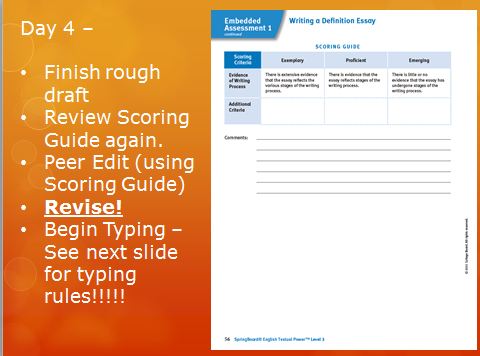
We are on day 4 of 5 which will really be day 4 of 7, but that's okay! I am encouraged. They are working hard and the quality appears to be there. I will post some samples when I get them. Here are some screen shots of my ppt that I use to pace it out. The teacher's guide doesn't really do this, so to keep my sanity, I DO!
| Day 1 - Still on track! |
| Day 2 - Still reteaching "function strategy" |
| Day 3 - Oh yeah, we did NOT do this yet! |
| Day 4 will be trying to do day 3! |
| Day 5 will be hopefully doing this!?Click here to get whole ppt if you need it! |
Monday, November 12, 2012
Needed to create something elementary!
Having taught middle school for the last 10 years, I needed to see something cute! So I created 4 templates that I am DETERMINED to use in my own classroom (because secretly, middle schoolers are still into "cute"). I will use these PLUS my November Scholastic Book Order fun worksheet that I also created. That will actually be perfect for the kids who finish their Embedded Assessment #1 before the others. :-)
Phew... needed a break.
Thursday, November 8, 2012
Oh... the pacing!
Please do NOT, and I repeat, do NOT feel like a failure if you cannot keep up with the suggested pacing. It is certainly a lofty, advantageous goal, but one that can leave you wondering just what in the heck you did all period since you barely made it through your daily announcements and "house keeping."
If you visit the SpringBoard online community (which I highly recommend), you will see many teachers (especially new to SB) who are super concerned about where they are vs. where they "should" be. I have seen pretty funny commentary about the pacing. One of my favorite comments was someone who said, "I don't think SpringBoard takes into account taking attendance, dealing with homework, and actually talking to the kids." I agree! If you truly stick to the pacing, you will be hard pressed to be able to capitalize on any teachable moments or have conversations that often teach more than what we originally planned. I have also learned that SpringBoard has shattered any patience that I still had in me for the misbehaved child! Oh no, we have NO time for your shenanigans buster. In fact, I have found that the students feel the busy-ness too and a lot of the typical unsavory middle school behavior is left to their other teachers who have a much less intense (and less fun, of course) class period. :-)
The pressure of the suggested pacing can be exacerbated if you are "tethered" to another teacher in the same grade level where the expectation is that you and the other teacher are on the same page on the same day. Frustrating, no doubt! Well, the best advice I have for this is just do what is best for YOUR individual students and know that by the end of about a 2 week period, most of the time you and your colleagues will end up pretty close to being back in the same spot. It just kind of works out that way (unless your colleagues are either a true slow poke or coffee-fueled maniac working the extremes?!)
Another good rule of thumb, just to keep your sanity in the beginning, double the suggested time allotted for each lesson. It will just make you feel a ton better and give you a little breathing room.
Finally, notice where any novel is being taught and perhaps flip that unit to the winter. I was very worried we would not finish the novel for Unit 3 in the Grade 7 curriculum (Tangerine) because I hadn't figured out the pacing yet and we had several weird (aka shorter) schedules during that time for different testing days. Soooo many of the full-on lessons went away as we had to spend many full class periods just reading the novel to make sure that we finished it before summer break!
Hang in there with the pacing and know that it does get faster as you get more comfortable too!
Sunday, November 4, 2012
Begin at the End - What IS an Embedded Assessment anyway?
What the heck is an Embedded Assessment and what does it mean to "unpack" it? Well, after the training I originally attended, I believed it was necessary to have a huge production for "unpacking" the embedded assessments. I was even advised to wear some sort of theme-enhancing costume and really jazz it up! I was onboard with this if I had to be, but come to find out, with the somewhat unrealistic rigorous pacing of SpringBoard, sporting some sort of academic outfit to blend metaphors with reality while literally unpacking a real suitcase, used as a prop, filled with sentence strips (or, even better - die cut shapes that match the theme) with the skills they would need to be successful on the embedded assessment printed on them fell by the wayside.
So what is the best way to start? At minimum, familiarize yourself with the Embedded Assessment that the students will be responsible for doing. Read the assignment and the rubric. A rule of thumb I have is double the amount of time they suggest you will need and prepare an alternate / fun assignment for early finishers.
A word of caution regarding Embedded Assessments: 1) they can take forever to grade (if you grade them as strictly as I do). 2) They aren't "assessments" in the sense that you are used to, and for that matter, your principal will think it is something that it isn't. It is a project-based way for students to showcase that they understand the overall concepts taught throughout the literature and writing activities leading up to the assessment. It is also a good preparation for the new state assessments we are all heading towards, in that it is, as I stated, project-based. They do the entire thing in class with the ability to use resources around them (like we would do in the real world). And finally, 3) You need to reference the rubric as often as possible during the weeks leading up to the assessment, and tie activities to the assessment whenever possible, i.e. "which skill on the embedded assessment will this activity help with?"
Back to unpacking... how to do it? Well the quickest way I found is to keep it simple. Follow the first actvitiy at the beginning of the unit. Spend as much time as you have in one class period discussing the final product and have the kids put it into their own language (they can take notes or just discuss) as best they can.
Next, I've made the necessary skills into mini-posters that are displayed in the room for the entire unit. You can use the box at the beginning of the teacher's guide to find the most user-friendly list of skills. Compare it to the rubric so that you and the students are clear on how they will be graded. Then, whenever we finish an activity, we add the activity # next to the skill poster so that we know WHY we just did what we did. I will inlcude pictures of what this looks like in my room.
I also started making graphic organizers for each unit with blank squares for the kids to keep a small version of what is on our board in their notebook. Again, I will attach pictures of this as well.
Don't spend more than one period introducing the Embedded Assessment. Instead, make sure they have a general understanding of what they are working towards. When you reference it (almost daily) as you progress through the activities, they will have a very clear understanding of what will be expected. This also helps the kids who were absent the day you revealed their project as well as any new kids who have entered your class.
Subscribe to:
Posts (Atom)